Is Free Shipping Really Free? The Truth Behind The Promotion

Most people shop by default: open the app, add to cart, check out. No drama. No digging. But sometimes the numbers stop you mid-checkout, and that is a useful moment. Why pay more when the exact same item appears cheaper elsewhere? Is Free Shipping Really Free?
This happened with a small, everyday product: the Pack of 3 Femme Essentials Interfolded Paper Towels (120 pulls). It was the exact same pack and quantity on two different platforms, yet the totals were vastly different.
Below we walk through the full breakdown, explain why big ecommerce marketplaces in the Philippines often cost more, and show how Low Price Dito provides a more cost-effective alternative.
The Side-by-Side Receipt
Let's eliminate all speculation. Here is the raw data for an order of 8 packs of Femme Essentials Interfolded Paper Towels on December 5, 2025.
| Metric | Major Marketplace | Low Price Dito | The Reality |
|---|---|---|---|
| Listed Price per Unit | ₱195.00 | ₱92.75 | Actual Retail price is 52.4% lower at the point of listing. |
| Item Subtotal (8 units) | ₱1,560.00 | ₱742.00 | The gap before fees is already a staggering ₱818. |
| Shipping Fee | ₱0.00 (Promoted as "Free") | ₱280.00 | The psychological battleground. |
| Vouchers/Discounts | ₱0.00 (Standard Price) | ₱0.00 (Standard Price) | Comparing apples to apples with no flash sales. |
| Final Amount Charged | ₱1,560.00 | ₱1,022.00 | The incontrovertible result. |
| Net Savings | - | ₱538.00 | This is 34.5% of the total order value saved. |
The Immediate Takeaway: The narrative of "free shipping" is dismantled by arithmetic. Even when saddled with a clear ₱280 delivery fee (based on a delivery destination in Santa Cruz, Manila), Low Price Dito's model results in the consumer keeping ₱538 more in their wallet. This is not just a bargain; it is a completely different economic equation.
Forensic Accounting: Tracing the ₱538 Leak
Where does that extra ₱538 go on the mainstream platform? It doesn't vanish. It gets meticulously carved up by the platform's ecosystem. To understand this, we must follow the money after a customer clicks "Pay."
1. The Seller's Painful P&L (Profit and Loss Statement)
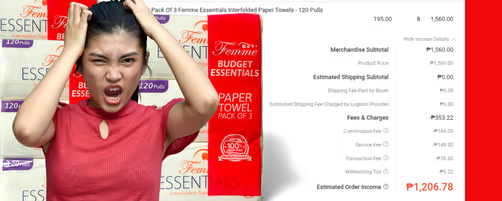
The seller on the big marketplace does not receive your ₱1,560. They endure a cascade of deductions. Based on standard fee structures for non-promoted listings, here is a likely breakdown:
- Customer Pays: ₱1,560.00
- Platform Commission (10-12%): -₱164.00
- Service Fee (2-4%): -₱149.00
- Transaction Fee: -₱35.00
- Withholding Tax (on fees): -₱5.22
- Seller's Actual Net Proceeds: ₱1,206.78
Before covering the cost of the goods sold, packaging, labor, or any business expense, the seller has lost over 22.6% of their revenue to platform fees.
2. The Seller's Dilemma and Your Inflated Price
Faced with this reality, the seller's calculation is brutal. They must cover the product cost (₱85 to ₱90 per pack) along with packaging and labor (₱10 to ₱15 per order) while still maintaining a reasonable 15% to 20% profit margin.
To hit their net target after losing ₱353.22 to platform fees, the only lever they can pull is the retail price you see. That ₱195 price tag is not greed; it is survival arithmetic in a fee-heavy environment. You, the buyer, are the one financing the platform's entire cut.
3. The "Free Shipping" Illusion: A Masterclass in Behavioral Economics
Why does this model persist? Because of a potent psychological trick known as Partitioned Pricing.
Human Bias & Psychology: Studies show consumers are more sensitive to extra fees (like shipping) than to an overall higher product price. A ₱92.75 item multiplied by 8 packs plus ₱280 in shipping feels more expensive than a ₱195 item multiplied by 8 packs with "FREE SHIPPING," even when the math proves the exact opposite.
The Embedding Strategy: Platforms encourage sellers to bake the true shipping cost plus a buffer for fee absorption directly into the product price. The "free shipping" badge becomes a marketing tool that actually justifies a price inflation of 40% to 100%.
The Low Price Dito Contrast: By separating costs, Low Price Dito rejects this obfuscation. The product price reflects a value closer to its true wholesale cost plus a fair margin, and shipping is presented as a transparent added service. This demands a more rational consumer but rewards them with total honesty.
How Low Price Dito's Pricing Works: Direct, Controlled, and Transparent
Important clarification: Low Price Dito is owned and operated by us. We sell our own inventory on Low Price Dito in addition to listing on major marketplaces. This means our pricing model is completely different from third-party sellers who must raise prices to cover marketplace fees.
Here are the four real reasons why Low Price Dito can sell the Pack of 3 Femme Essentials Interfolded Paper Towels for ₱92.75 instead of ₱195 while still maintaining healthy and honest margins:
- Direct Ownership of Inventory: We buy in bulk directly from manufacturers and distributors. There are no resellers and no middle-layer pricing. Because we control procurement, we eliminate unnecessary markups and price closer to the true landed cost.
- No Marketplace Commission Deductions: On major marketplaces, our listings are subject to commissions, transaction fees, service fees, ads, and promotions, all of which inflate the selling price. On Low Price Dito, none of those fees exist.
- Streamlined In-House Fulfillment: We pack and ship orders through our own optimized logistics workflow. Because we control fulfillment end-to-end, we reduce handling costs and avoid the inflated last-mile charges often embedded in "free shipping" claims on big platforms.
- Zero Gimmick Pricing: Our prices do not include hidden shipping costs, forced discounts, promo requirements, ad-spend recovery, or algorithm-driven markups. What you see is the real price alongside straightforward delivery fees shown upfront.
In short, Low Price Dito is cheaper because we own the products, control the pricing, and do not burden customers with marketplace fee inflation. The savings are real and quantifiable, just like the ₱538 difference in this case study.
The Annual Household Impact: It's More Than Pocket Change
Saving ₱538 on paper towels is an arresting figure. But its true power is realized when scaling to a household's annual consumption.
| Household Essential | Approx. Monthly Spend (Big Platform) | Estimated Savings (Switching Model) | Projected Annual Savings |
|---|---|---|---|
| Paper Products (Towels, Tissue) | ₱1,500 | 30-35% | ₱5,400 to ₱6,300 |
| Laundry & Cleaning Supplies | ₱2,000 | 25-30% | ₱6,000 to ₱7,200 |
| Canned & Packaged Groceries | ₱3,000 | 20-25% | ₱7,200 to ₱9,000 |
| Personal Care (Soap, Shampoo) | ₱1,200 | 20-30% | ₱2,880 to ₱4,320 |
| Conservative Annual Total | - | - | ₱21,480 |
| Aggressive Annual Total | - | - | ₱26,820 |
The Realization is Stark: We are not talking about loose change. We are talking about a potential family vacation, a major appliance upgrade, or a significant investment contribution being eroded by systematic overpayment on mundane goods.
The Actionable Playbook for the Modern Filipino Shopper
Awareness is futile without action. Here is your tactical guide:
- Benchmark the "Boring Stuff": Start with your consumables, which are items you buy repetitively with little brand emotion. Think paper towels, detergent, soap, rice, and cooking oil. These are the items where fee inflation is most pronounced and savings are most consistent.
- Calculate the FINAL Price, Always: Ignore the item price. Open a notepad or calculator app. Item Price plus Shipping Fee equals Final Price. This simple act pierces through the "free shipping" marketing veil.
- Embrace Multi-App Carting: Do not be loyal to a platform. Be loyal to your budget. Have the major marketplace, Low Price Dito, and perhaps another value-focused app installed. Your pre-checkout ritual should be a two-minute, three-app price review.
- Re-evaluate "Convenience": True convenience is financial efficiency, not just a saved password. The "convenience" of one-click checkout on a premium-priced platform is an expensive luxury.
- Think in Bulk, Act on Value: Savings magnify with quantity. When you find a true price advantage on a consumable, buy the rational bulk amount. The storage space is a better investment than the platform's fee pool.
- Track Your Monthly "Leakage": Keep a simple spreadsheet of your top 10 recurring purchases. Note the price difference between platforms each month. Seeing ₱500 here and ₱300 there adds up to real visibility, and you will quickly identify which items carry the biggest "convenience tax" on mainstream apps.
- Understand Seller Patterns: Major sales events (9.9, 10.10, 11.11, 12.12) often have genuine discounts but also inflated "original" prices. Check the item's price history if possible. Sometimes the "sale" price on a big platform is still higher than the everyday price on Low Price Dito. Do not let countdown timers rush you into a bad deal.
- Build Your Trusted Seller Shortlist: When you find a seller on any platform with consistently good prices and reliable service, save their store. Cross-check if they sell on multiple platforms, as they often have better prices elsewhere due to lower fees or no fees at all. Loyalty should be to the seller rather than the platform taking a cut.
Pro Tip: The "Three-Click Rule" for Smart Shopping
Make this your new habit: Before any online purchase of ₱500 or more, give yourself three clicks:
- Click 1: Check the price on your default or go-to platform.
- Click 2: Open Low Price Dito webapp and search for the same item.
- Click 3: Compare the FINAL totals (including shipping) and make your decision.
This 30-second habit applied consistently could save the average Filipino household ₱15,000 to ₱25,000 annually based on our case study projections.
References & Data Sources
- Shopee Seller Fees - What are seller fees?
- Lazada Seller Center: Fees Overview
- Wholesale Dito Store : Lazada Unjust Wrong Weight Fees on Sellers
- iPrice Group & Cube Asia. (2023). The State of Ecommerce in Southeast Asia.
- Partitioned pricing, price fairness perceptions, and the moderating effects of brand relationships in SME business markets
- Meltwater & We Are Social. (2022). Digital 2022: The Philippines.
- Empowering MSMEs: The Backbone Of The Philippine Economy
- PwC. (2023). Global Consumer Insights Pulse Survey. Consumer transparency demands.
- Baymard Institute. (2023). Cart Abandonment Rate Statistics. Checkout friction research.
- Republic Act No. 7394. (1992). The Consumer Act of the Philippines. Official consumer protection law.